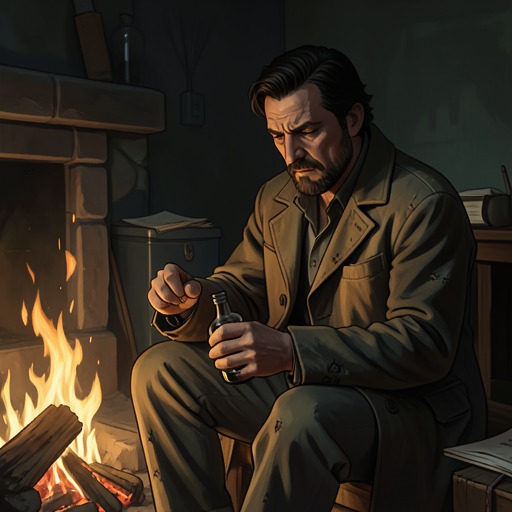
Patrick Sumner’s opium dependence
The North WaterPatrick Sumner’s opium dependence is presented as both a continuing need for laudanum and a vulnerability made acute by the Arctic expedition’s conditions. The medicine sometimes helps him sleep, but not reliably; when his supply is accidentally left aboard the Hastings, he cannot replace it while trapped on the ice. His withdrawal unfolds amid storm, fire, and uncertainty, making dependence a material condition of survival as well as a private struggle.
Dependence and Unsettled Sleep
Even when Sumner has access to laudanum, its help is limited. After Joseph Hannah’s death, he cannot sleep for more than an hour or two at a time, despite taking the medicine. His distress is bound to the murder and its aftermath: he cannot accept the crew’s confidence that McKendrick is guilty and will be punished, and remains troubled by the contrast between Hannah’s dead body and McKendrick’s exposed, passive figure in the captain’s cabin. In his mind, the two bodies ought to fit together as parts of one explanation, but he cannot make them match. The passage therefore distinguishes the drug’s limited aid to sleep from the unresolved disturbance that keeps him awake.
Laudanum is not shown as a simple remedy that restores Sumner to ease. His sleeplessness persists alongside memory and doubt, and the book gives no indication that medication resolves either. Dependence matters here not only because he needs the drug, but because even access to it cannot protect him from the mental pressure surrounding Hannah’s death. The episode establishes a pattern that returns under more dangerous circumstances: sleep remains fragile, and the medicine can at best offer incomplete relief.
Physical Labor and Temporary Relief
The expedition’s demands repeatedly place Sumner’s use of laudanum within the routine of physical exhaustion. While helping the crew cut a dock through thick ice and clear it with gunpowder, he grows weak and wretched from the labor. After eating in the mess, he takes a dose and settles in his cabin. He falls asleep readily, but the surrounding ice repeatedly wakes him with the forceful impacts of floes colliding. The drug permits sleep to begin; it cannot secure it against the environment.
Those interruptions also connect his present Arctic circumstances with remembered danger. The percussions of the ice bring back the sound of artillery and shells from the ridge at Delhi. Sumner responds by stuffing his ears with cotton wool and reminding himself that the ship and its dock are secure. This contrast is significant to his dependence: laudanum is one means of rest, but neither it nor the reassurance he gives himself can fully separate him from the pressures that interrupt that rest. The chapter moves from a dose followed by sleep to waking amid an environment that the ship’s crew cannot control.
The Supply Left Behind
When a violent storm traps the crew on the ice, Sumner discovers that the medicine chest containing his opium has gone aboard the Hastings. His sea chest has gone with it, carried in the first party’s supplies by mistake. The loss is not a deliberate withholding of medicine: the account presents it as a packing error, one Sumner blames partly on his own inattention to his necessities and partly on Jones-the-whale’s failure to check what the boats carried. With the storm preventing a return, that logistical mistake becomes an immediate personal crisis.
At first Sumner tells himself that one night without opium is manageable. He knows, however, that a second night would make him sick if the storm continues to hold them on the floe. He tries to redirect his mind toward remembered places and routines: Belfast, drinking whiskey at Kennedy’s, rowing on the Lagan, and talking with acquaintances in the dissecting rooms. These recollections offer imagined distance from the ice, but they lead only into a murky, restless drowse rather than restorative sleep. The detail makes clear that his dependence persists even when his attention turns elsewhere: remembering familiar life does not replace the missing drug.
Withdrawal in the Storm-Bound Camp
As the crisis continues, Sumner’s condition worsens while the crew faces immediate threats from weather and moving ice. After a floe lurches and the camp’s stove sets bedding and clothing alight, the men take refuge beneath tarpaulins in the remaining whaleboats. In this cramped shelter, Sumner lies sleepless as his muscles and internal agitation register the unmet need for opium. He tries again to imagine himself somewhere happier, but cannot make the effort succeed. His withdrawal is thus described through an accumulating failure of ordinary means of relief: he cannot take his medicine, cannot sleep, and cannot mentally leave the circumstances surrounding him.
By the following day, with snow falling and provisions already a concern, Sumner is shuddering and aching; his eyes itch and throb, and he is unable to sleep or urinate despite a strong desire to do both. Fragments of The Iliad pass through his mind as he lies in the tent, linking his impaired attention to a literary memory rather than a sustained, orderly train of thought. The episode remains grounded in his physical state and the conditions of the camp, without suggesting that the remembered poem relieves his symptoms. The narrative’s sequence makes the dependence especially consequential: a supply error, prolonged storm, and isolation on the ice turn an established need into escalating distress, at the same time that the crew’s options and provisions are narrowing.